The history of the blue cord | Of the elite to the canteen

Everyone believes to know the blue cord, without really knowing the story of the blue cord. You may have discovered it at the canteen, frozen ray or in a small neighborhood restaurant. Yet behind this stuffed escutcheon is a much more aristocratic story.
The story of the blue cord starts in the kings' salons, passes through the big nineteenth century stoves, before finishing in star of the meal trays. Between Swiss legend, French imagination and American influence, this dish alone embodies the democratization of the culinary prestige.
By retracing this amazing story, we will see how a symbol of elite has become a popular classic, sometimes decried, but rarely forgotten. And why, despite his dish image of canteen, the blue cord remains luxurious in our gastronomic imagination.
The Blue Cord: from the Swiss elite to the canteen, the incredible history of the blue cord
Reading time: ~ 10 min
- History of the blue cord of the prestigious ribbon with gourmet compliment
- Of the noble expression to the packed flat dish
- From the Chatte restaurant: how the blue cord has traveled
- Why the blue cord is still fascinating
- FAQ on the history of the blue cord
History of the blue cord of the prestigious ribbon with gourmet compliment

Knights with exceptional banquets
Before being a dish, the blue cord is a ribbon. In the sixteenth century, the order of the Holy Spirit, an order of chivalry founded by the kings of France, distinguished its members by a large blue ribbon worn in necklace. This blue cord becomes one of the most exclusive symbols of the monarchy, reserved for the highest dignitaries.
Over time, this prestigious ribbon is no longer limited to weapons and securities. He moves to the table. Banquets offered to these knights are known for their refinement. Little by little, we start talking about blue cord meals to designate exceptional feasts, served at guests sorted on the component, cooked by admired teachers.
Birth of the term "blue cord" in the kitchen
In the nineteenth century, semantic shift is completed. The blue cord is no longer just the sign of an order of chivalry; It is also the nickname of cooks and stoves of very high level. Being a blue cord means to know how to prepare refined dishes with great mastery. The expression enters into the current language to designate any person who is particularly subject to the furnaces.
Amazing, this figurative sense precedes the appearance of the dish that we call today blue cord. For a long time, we are talking about blue cords without it still existing stuffed escalope that officially wears this name. It is only in the twentieth century that the story of the blue cordon takes a very concrete turning point, on the plate.
Of the noble expression to the packed flat dish
The French track between improved chop and gourmet compliment
One of the most frequently cited hypotheses sets the birth of the blue cord in France, as a kind of improved calf chop. A renowned cook, a real blue cord, would have had the idea of sliding ham and cheese into a fine cutlet, then pranging to get a generous and elegant dish.
In this version, the name of the dish would be a direct tribute to the cook's talent, almost a wink. The blue cord is called a creation of artist by the name of his medal. Others prolong this idea by explaining that the level of refinement of the recipe would make it worthy of a blue cord meal.
Sources already mention at the beginning of the twentieth century calf preparations called blue cord, where a chop is enriched with more luxurious trim. But these occurrences remain punctual and are not enough to definitely fix the current form of the stuffed dish with ham and cheese, and then golden.
The Swiss Trail and the Legend of Brig
On the Swiss side, we find the most detailed story about the origin of the blue cord as we know it. In the Valais, in Brig, a history has been circulating for a long time: an inn cook should have, a day of high influx, feed two great tables with a quantity of meat a little short.
To cope, she would have split her escalopes, slipped between two layers of ham and cheese, then pierced everything to give the dish more volume and greed. Customers, delighted, would have offered him a blue cord decoration. She would have refused the distinction, preferring that we give this name to her dish. Thus would be born the blue cord in a small Swiss city, on the border between hardiness and ingenuity.
Beyond the legend, several indices reinforce the Swiss track. A Helvetic cookbook of the late forty-colors described a cottage with the Farcie cheese, very close to what we call blue cordon, long before the term is broadly broadcast. German-speaking sources also evoke the Schweizerschnitzel, stroke Swiss escalope, like probable ancestor of the modern blue cord.
This version framework with the cultivation of Farcited Schnitzels in Central Europe, while leaving Switzerland a central role in the invention of the dish. It also agrees with the fact that the blue cord is really popular in Switzerland than in the second half of the twentieth century, which corresponds to its diffusion outside the very local circles.
Other tasty hypotheses about the origin of the name
Around these two large families of explanations gravitate many variants. Some talk about blue cords of fabric or string, actually used to maintain stuffed strokes closed during cooking; With this in mind, the name of the dish would literally descriptive rather than symbolic.
Others offer an older Italian origin, where blue cords of blue colored would have been used to link rolled meats. These stories are however not documented and face the lack of solid written traces before the twentieth century.
Finally, a linguistic interpretation clearly separates the expression being a blue cord of the dish name. For some authors, there would be no direct link between the two; The dish would have simply recovered a term that, in the culinary world, already mentioned the high quality. Giving this French name to a schnitzel stack recipe, especially abroad, allowed to give it an immediate prestige.
From the Chatte restaurant: how the blue cord has traveled
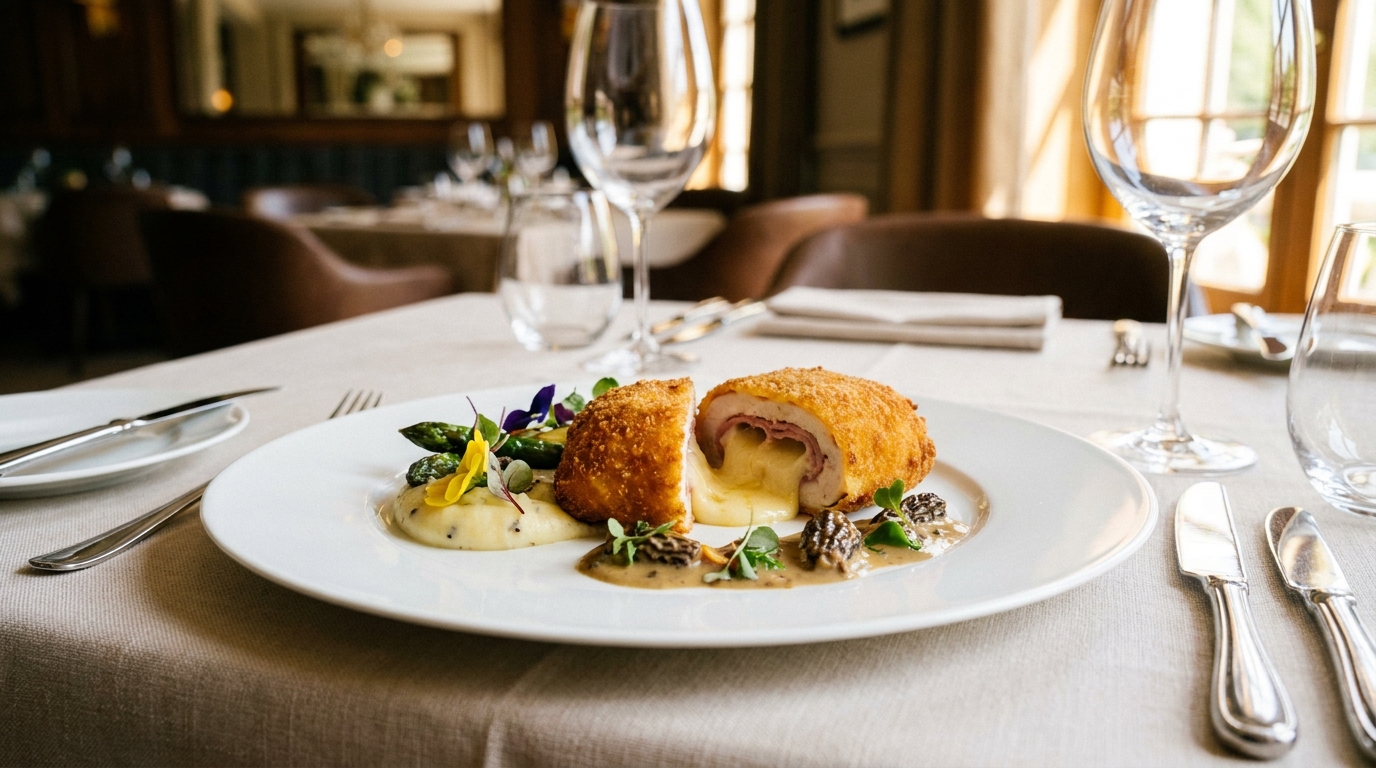
A prestigious dish in restaurants
In the mid-twentieth century, the history of the blue cordon takes an international dimension. Mentions of "Veal Blue Cord" appear in the press and menus in the United States, in a context of rather high-end gastronomy. The French is then the language of culinary chic, and the simple fact of writing "blue cord" on a map is enough to suggest European refinement.
A few decades later, the "Chicken Cordon Bleu" is cited by great American newspapers. It is then on refined restaurant cards, often with other francized classics. We sometimes find his inspiration in the Wiener Schnitzel Viennese and the Chicken Kiev, two other specialties of Stuffed Panés, very appreciated on the Atlantic.
The development of collective catering
But this success in luxury restaurants does not last forever. The blue cord is a technically simple dish to reproduce in series: a fine cutlet, a cheese that melts well, a slice of ham, a crisp crunch. All this lends itself perfectly to industrial manufacturing.
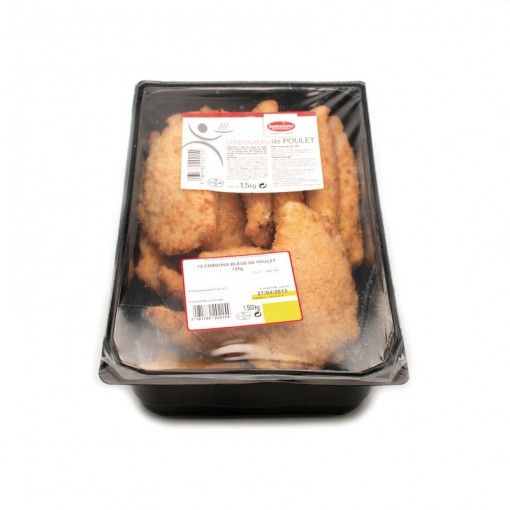
As frozen breaded products develop, it becomes a reference for collective restoration. School canteens, Corporate Restaurants, Hospitals, Self-Services: All adopt this easy-to-store preparation, portion and warm up.
A classic supermarket rays
The same logic applies to retail trade. In the form of fresh or frozen products, the blue cord settles in the rays of supermarkets, losing little by little a restaurant dish to become a basic of everyday life. He then joins other international variants of stuffed breadmeats, such as the Spanish San Jacobo or some South American Milaneas.
This descent of bourgeois tables to the canteen is not necessarily synonymous with decay. Rather, it illustrates how a symbol of distinction can be democratized, sometimes until excess, to the point of being reduced to a simple breathtaking tray.
Why the blue cord is still fascinating
A name for luxury culinary
Despite his image of childhood dish, sometimes deemed industrial, the blue cord retains a special aura. First because of his name. Even when you buy a blue chicken cord in a tray, you mobilize without a heritage of blue ribbons, prestigious knights and big cooks greeted as blue cords.
This dish is also at the crossroads of several culinary imaginaries: it evokes both the tradition of Viennese escalves, the creativity of a Swiss hostel and the French varnish of the elegant restaurants of the post-war. It tells how the boundaries between national cuisines are blurring when the recipes circulate, mix and translate.
A dish between popular culture and high cuisine
There is also a striking contrast between the blue cord as a canteen dish and "The blue cord" as a prestigious cooking school. On one side, a breaded product often associated with the practical quotient; on the other, an institution that forms high level leaders. This great symbolic gap further strengthens the cultural dimension of our stuffed escutcheon.
Finally, the blue cord remains a tremendous reinvention support. Many leaders have fun, offering generous home versions, with beautiful cheeses, local hams and quality meats. By reworking this popular classic, they renew with its original flat vocation worthy of a blue cord, in the most noble sense of the term.
FAQ on the history of the blue cord
Is the blue cord really a French dish ?
The term "blue cord" comes clearly from France, via the order of the Holy Spirit then the great cooks. On the other hand, the origin of the packed plate is played. Many sources are leaning for an invention in Switzerland, in Brig, in the first half of the twentieth century, even if a French tradition around enriched calf chops also exists.
Why do we say "to be a blue cord" to talk about a good cook ?
Historically, the members of the Order of the Holy Spirit wore a large blue ribbon, a symbol of a very high social rank. The banquets associated with this order being particularly neat, the term "blue cord meal" ended up designating refined meals, then the people able to prepare them. From there comes the modern sense of blue cord for a person endowed in cooking.
Is there a direct link between expression and dish ?
Both are bound by prestige. The expression existed before the dish and already designated culinary excellence. The dish would have resumed this term to present itself as a particularly neat preparation, worthy of a blue cordon. Some theories also evoke blue cords used to keep meat stuffed, but this material explanation is less attested.
Is the blue cord inevitably based on veal ?
Historically, the first documented versions often mention the calf. Very quickly, however, the recipe comes with pork or chicken. Today, for many consumers, especially out of mainland Europe, the chicken blue cord has even become the norm.
How did the blue cord spent high cuisine with the canteen ?
Its form makes it very suitable for industrial production. Once large-scale breeding and freeze and freezing techniques, it has become a convenient product for collective catering and retail. Its prestigious name has probably facilitated its adoption, before this massive diffusion gives it the image of canteen dish that we know.
From the blue ribbon of the Knights to the golden breadth of our plates, the history of the blue cordon thus tells the circulation of the culinary prestige, from the elite to everyday life. Understanding this course allows you to look differently this dish that we thought we were thinking and can make you want to rediscover it in a more generous and more gastronomic version. To continue to explore this gourmet story and find inspiration, you can go through our universe of products and recipes on Very Gourmand.
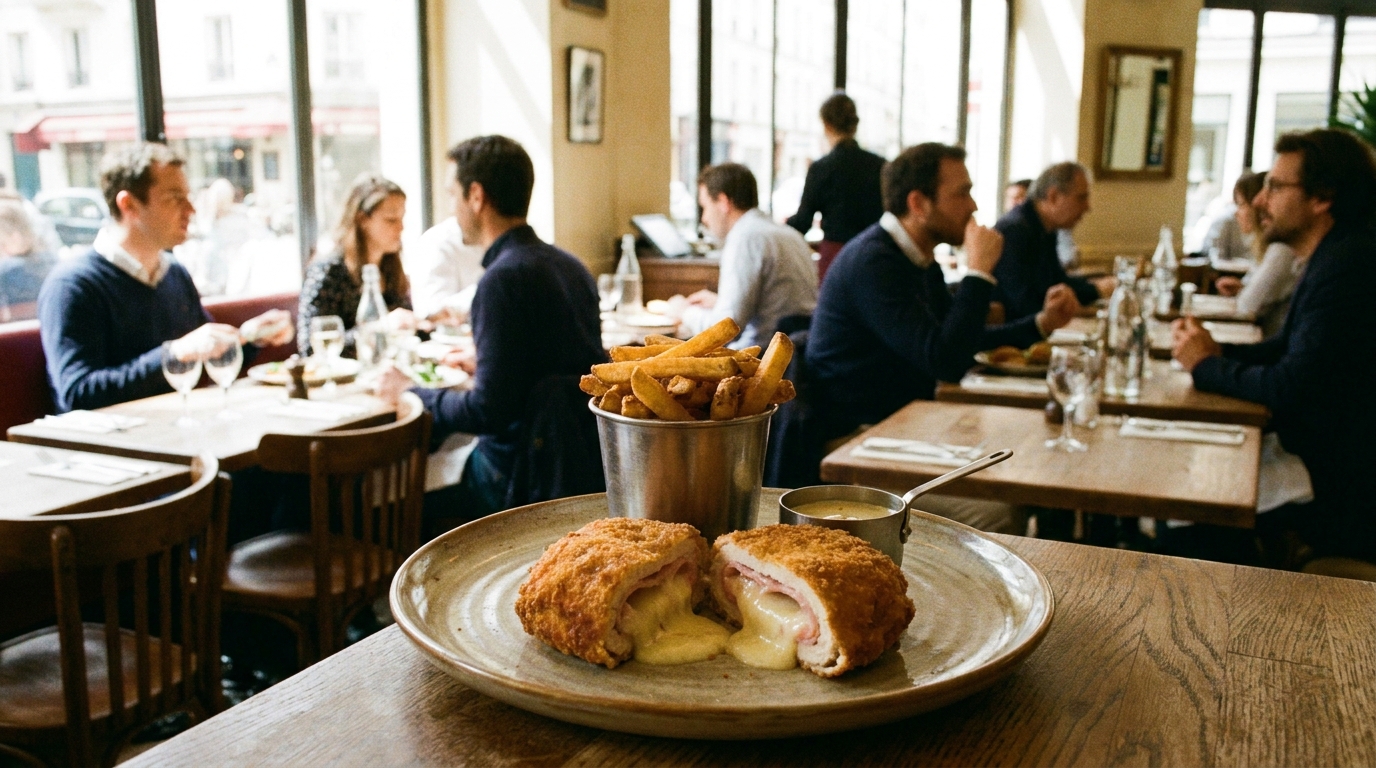
Conclusion: a blue cord between prestige and daily
From the order of the Holy Spirit to the canteen trays, the history of the blue cord shows how a symbol of distinction can become a popular classic without losing its aura. Between French and Swiss hypotheses, Viennese influences and industrial adaptation, this dish embodies the way the culinary prestige is spreading, turning and reinventing it. Rediscovering it with good products is to reconnect with this double identity: that of a daily dish, but also a real gourmet blue cord.