


10 FRENCH CHEESES TO TASTE ABSOLUTELY

Cheese is serious business in France: it is estimated that people consume more than 20 kg of it per person per year and that more than 1000 different kinds are produced throughout the country. Among these, 45 benefit from the AOC (Appellation d'Origine Contrôlée) and 38 from the AOP (Appellation d'Origine Protégée).
We have selected for you what we think are the 10 French cheeses that you should taste at least once in your life.
1. County
Comté is quite possibly the best known and most appreciated French AOP cheese. Every year, about one and a half million cheeses are produced, and each of them weighs about 20 kg. The cheese tastes sweet and oily despite being matured for at least 4 months. The paste is characterized by the fact that it changes color and consistency according to the seasons: it is a semi-hard paste of ivory color during the winter, while it turns into a cheese with a buttery consistency and a straw yellow as summer progresses.
The best way to enjoy it? Use it for fondue.
2. Pie chart
Almost as famous as Comté cheese, Camembert is considered the symbol of the Normandy region. This cheese is characterized by a very strong smell, a soft and creamy texture and a white and bloomy rind. It seems that the way this cheese was made dates back to the French Revolution. It is said that it was a runaway farmer from the Brie region who taught a farmer from the village of Camembert how to prepare it.
3. Brie
Brie is produced in the French region of the same name, which is about fifty kilometers from Paris and has benefited from the AOC since 1980. This raw milk cheese, characterized by a soft and supple paste and a white and flowery rind , is one of the most exported French cheeses in the world. It may look like Camembert, but unlike Camembert, it takes 8 weeks to make instead of 4 weeks.
During a stay in the French capital, due to its proximity to the Brie region, among the dishes to be tasted in Paris, we recommend this cheese, king of the cutting boards for an aperitif, but also perfect for preparation of sandwiches with grilled vegetables.
4.Cantal
The name of this cheese comes from the region of the same name in the Auvergne-Rhône-Alpes region, the only place where it can be produced. Cantal has a long tradition behind it and has been consumed by the French since
Middle Ages. It is an uncooked pressed cheese called mie (crumb) because of its crumbly texture. The best way to taste it is to taste it in all purity.
5. Reblochon
With its circular, pleated shape and soft, creamy, oily texture, Reblochon is a cheese produced at high altitude during the summer months spent in the mountain pastures. The territory is that of Haute-Savoie.
It is usually served with pain de champagne, a naturally leavened bread, but it is also excellent melted or baked.
6. Beaufort
Beaufort is a fatty hard cheese with a medium to long ripening period. This takes place in humid cellars that characterize the strong taste that the cheese acquires with aging. This cheese is part of the Gruyère family and is considered the king because of its size: a cheese weighs around 50 kg. Unlike most Swiss cheeses, it has no holes inside and is not a washed rind cheese.
7. Goat
For centuries, fresh goat's cheeses were considered less noble and of everyday use, but today they are essential on the tables of the French and on the tasting tables. Goat cheese lends itself to many preparations: from salads to canapes.
8. Cancoillotte
Legend has it that this creamy cheese was born from the struggle of two giants: Cancoillotte and Yotus. During the fight, Yotus dropped a pot of curdled milk into the fireplace cauldron and Cancoillotte, the winner of the fight, named the cheese after him. Cancoillotte is produced in the East of France and especially in Franche-Comté. It is made from a block of curdled milk: this is heated and slowly melted by adding water or milk and butter. It can be eaten both cold and hot and is excellent spread on bread.
9. Roquefort
Roquefort is one of the most famous French cheeses. Characterized by green-blue streaks, this herbal sheep's cheese ages for at least 90 days in caves on the slopes of the Combalou mountain.
The history of Roquefort dates back to the 11th century and is a historical symbol of the Causses region and the valleys of Aveyron.
10. Auvergne Blue
Finally, the last of the French cheeses we recommend you try is Bleu d'Auvergne, similar to Roquefort but made with cow's milk. The cheese was born in 1850 thanks to an experiment of a young farmer who tried to contaminate the milk with some blue mold found on rye bread.


Rocamadour creamer with PDO raw goat's milk - 12x35g


Roquefort AOP with raw sheep's milk - 350g


PDO raw milk goat banon - 100g


Bleu d'Auvergne 45% PDO ±1kg


Old Cantal PDO ±600g


Little Mountain Blue - 250g


Farmer Brie de Meaux PDO with raw milk 1/4 ±625g


Camembert AOP Isigny with raw milk - 250g


Brie de Meaux with raw milk PDO - 1.5kg


Cantal PDO ±1kg


County 5-7 months AOP with raw milk ± 1kg
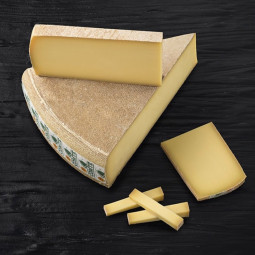


Cantal entre-deux PDO ±1.25kg


Palets of fresh goat cheese 12x20g


Unpasteurized Blue Label Camembert ±150g


